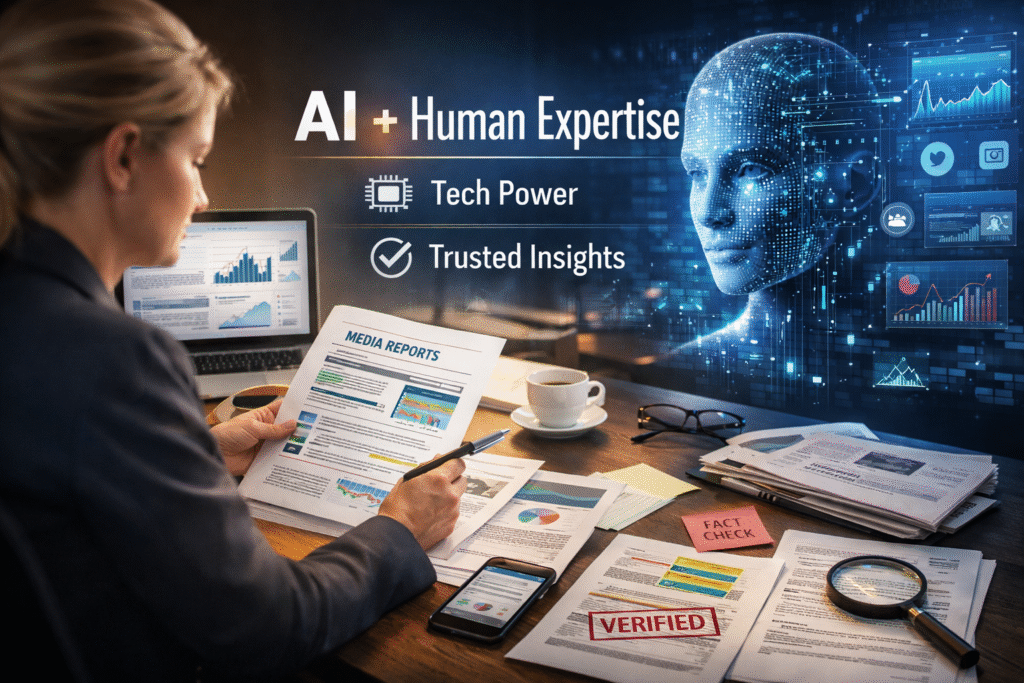
Why Human Curation Still Matters in Media Monitoring—Even in the Age of AI
Artificial intelligence has transformed media monitoring and social media listening. Automated data collection, sentiment analysis at scale, real-time alerts, and pattern detection have dramatically increased speed and coverage. In many ways, AI has become indispensable.
And yet, amid all the hype, one truth remains unchanged: when insights are intended for upper management and decisions carry real consequences, human judgment is not optional—it’s critical.
At a time when organizations are inundated with data, the real value lies not in collecting more information, but in delivering the right, validated, and contextualized insights. This is where human curation continues to play a vital role.
AI Is Powerful—But Power Is Not the Same as Understanding
AI excels at scale. It can scan millions of articles, posts, videos, and comments in seconds. It can detect spikes, track keywords, and cluster conversations efficiently.
However, executive reporting is not about volume—it’s about meaning.
AI systems:
- Struggle with nuance, sarcasm, and cultural context
- Can misclassify sentiment in complex or sensitive topics
- Often lack awareness of organizational, political, or market-specific subtleties
- May surface irrelevant or misleading content if left unchecked
For upper management, a false signal or misinterpreted trend is not a minor inconvenience—it can influence strategy, reputation management, investor relations, or crisis response.
Executive Reports Require Judgment, Not Just Data
Media monitoring reports for senior leadership are fundamentally different from operational dashboards.
They must be:
- Concise – Executives don’t need everything; they need what matters
- Relevant – Aligned with business priorities, risks, and opportunities
- Accurate – Free from false positives, misinformation, or unverified claims
- Actionable – Clearly explaining why something matters and what to do about it
Human curators bring something AI cannot replicate: editorial judgment.
They decide:
- Which stories truly matter and which are noise
- How to frame insights in a business-relevant narrative
- What context is required to understand impact
- When a trend is meaningful—and when it’s just momentary buzz
This distinction is especially important when reports are read in boardrooms rather than data science teams.
Validation Is Not a “Nice to Have”
One of the biggest risks of fully automated monitoring is unverified information.
AI can surface:
- Duplicate stories reported as multiple “sources”
- Outdated or recycled news presented as new
- Speculation, rumors, or low-credibility content
- Misattributed quotes or incomplete context
When insights are escalated to upper management, validation becomes essential.
Human analysts:
- Cross-check sources
- Assess credibility and influence
- Confirm whether information is factual, speculative, or opinion-based
- Flag uncertainty instead of presenting assumptions as facts
In an era of misinformation and rapidly spreading narratives, this human validation protects organizations from making decisions based on flawed inputs.
Context Turns Monitoring into Intelligence
Data without context is just noise.
Humans understand:
- Industry dynamics
- Historical background
- Brand-specific sensitivities
- Regional, cultural, and political implications
For example:
- A spike in negative sentiment may be irrelevant if driven by a non-core market
- A viral post may appear influential but come from a low-credibility source
- A seemingly neutral article may carry strategic implications depending on timing
AI can identify what is happening.
Humans explain why it matters.
That distinction is what turns media monitoring into true intelligence.
The Future Is Not AI or Humans—It’s AI and Humans
The most effective media monitoring programs don’t treat AI as a replacement for human expertise. They treat it as an amplifier.
AI handles:
- Scale
- Speed
- Pattern detection
- First-level filtering
Humans handle:
- Curation
- Validation
- Interpretation
- Strategic framing
Together, they produce insights that are:
- Faster than traditional manual methods
- More accurate than fully automated outputs
- More relevant to decision-makers
This hybrid approach is not a step backward—it’s a competitive advantage.
Less Hype, More Impact
AI will continue to evolve, and its role in media monitoring will only grow. But for organizations that rely on media intelligence to guide high-stakes decisions, human curation remains irreplaceable.
Especially when:
- Reports are consumed by upper management
- Reputation, compliance, or strategy is at stake
- Information must be validated, not just detected
In the age of AI hype, the real differentiator isn’t who uses the most automation—it’s who combines technology with human expertise to deliver insights leaders can trust.